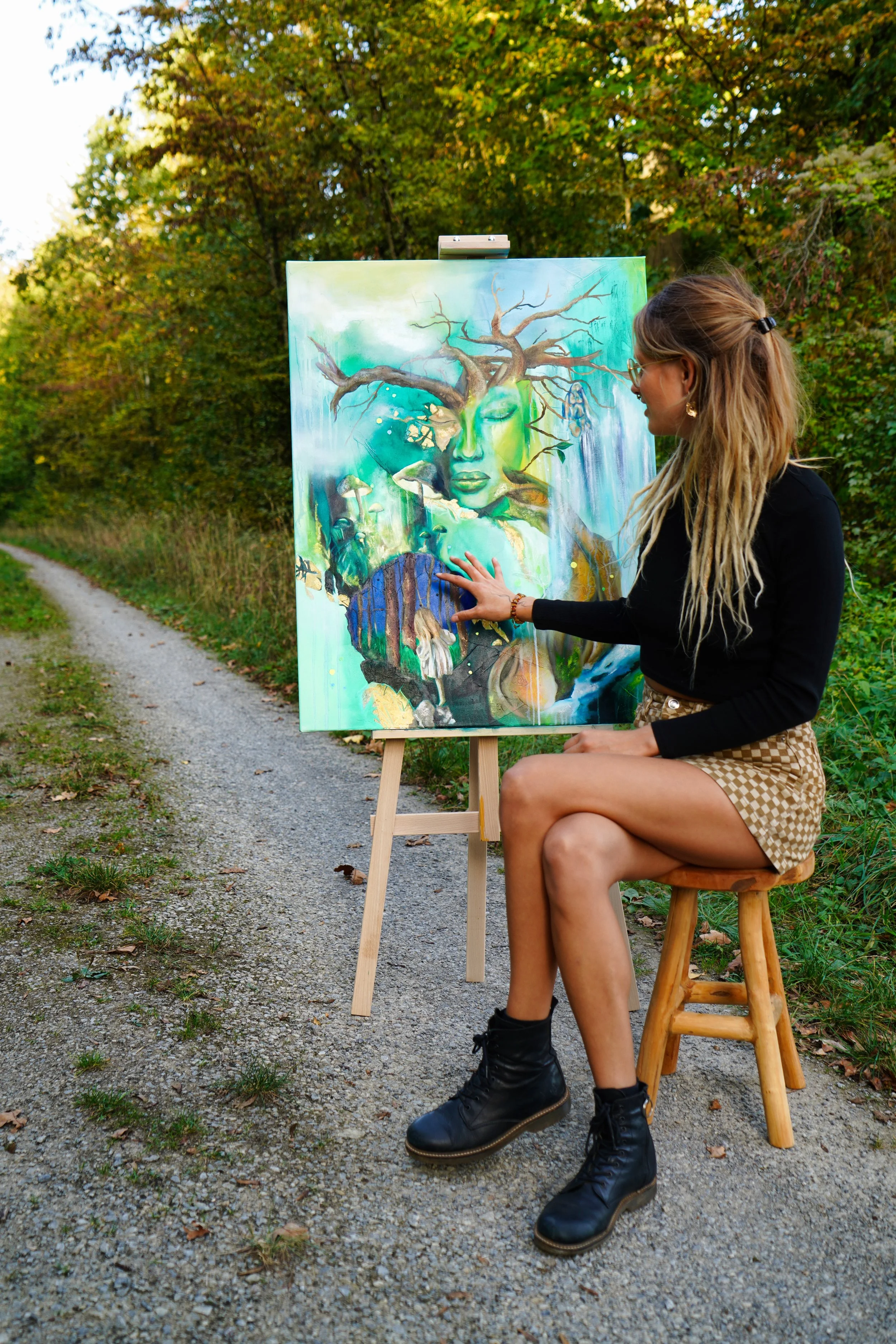
Through oil and mixed media, Jessi paints abstract-surreal worlds shaped by questions of who we are, how we break, and how we heal.
Jessi’s Story
Born and raised in Germany, Jessi lives at the intersection of art, travel, and the study of the human spirit. A social worker by profession and currently pursuing her Master’s degree in psychology, she approaches painting as both an introspective journey and a dialogue with the world.
Together with her partner, she travels across continents, seeking out cultures, landscapes, and stories that spark inspiration and challenge perspectives.
Her creative journey began as a quiet rebellion — a defiance of convention that turned into a daily practice of embracing the unknown. In 2022, she committed to deepening her craft through The Milan Art Institute’s Mastery Program, completing two years of intensive study that refined both her technical skills and artistic voice.
Influenced by surrealism, whimsical figurative art, folklore, and the symbolic language of nature, Jessi creates work that exists in a hybrid space between traditional and contemporary. She preserves the rich intricacies of oil painting while layering in modern palettes, textural experiments, and spontaneous mark-making. “Happy accidents” are embraced, becoming portals into organic forms and hidden meanings.
Her dual background in social work and psychology shapes the narratives within her paintings — exploring resilience, transformation, and the layered beauty of being human. Each piece begins from personal memory or emotion, yet evolves into a dreamlike, multi-layered space where viewers are invited to uncover their own interpretations.
Through her art, Jessi seeks not only to create beauty, but to expand perception — to challenge what we think we know, and to reveal what lies beneath.
“My creative process moves through cycles of deconstruction and reconstruction, again and again. It began as a way to confront the perfectionism that once kept me paralyzed — the fear of judgment and the weight of self-doubt. Over time, it became more than an act of release; it evolved into a surreal visual language, a way of building dreamlike worlds as both an escape from reality and a reflection of it.”